


Sexual orientation: Queer, pan, fluid … Your guide to the topic
Does your label no longer fit you? Good news: you don’t have to stick with it. For a long time, sexual orientation was discussed using just a few terms: heterosexual, homosexual, bisexual. For many people, these terms are still accurate, useful and important. For others, however, they only tell part of the story.
Today, the terms used to describe sexual orientation are evolving, particularly amongst younger generations. Queer, pansexual, asexual, demisexual, fluid… these terms are cropping up more and more frequently in dating app profiles, in conversations amongst friends, in TV series, on social media and in LGBTQ+ spaces. And no, this isn’t just a ‘trend’. Above all, it’s a way to better express who you are, what you feel, or sometimes even what you don’t yet want to define.
The key message to take away? Terms relating to sexual orientation are there to help you feel comfortable, not to limit you.
Why traditional terms have had their day
For a long time, these classic terms served as points of reference. They enabled millions of people to name their sexual orientation, to recognise themselves, to come together and to demand their rights. They therefore remain valuable. But they are not always sufficient to describe the diversity of experiences.
Sexuality isn’t always a straight line with a starting point, a destination and a ‘destination’ sign. For some people, attraction depends on gender. For others, it depends on the emotional connection, the energy, the context, the person themselves, or it changes over time. This is where the concept of fluid sexuality comes into play: it recognises that a sexual orientation can shift, become more specific or evolve.
This trend is particularly evident among Generation Z. Many young people prefer more open, nuanced and less binary terms when talking about their sexual orientation. Not because they want to complicate things, but because they wish to avoid reducing an intimate experience to a label that is too narrow.
What does ‘queer’ mean?
The question ‘What does queer mean?’ often arises, as the term may seem broad. And that is precisely where its strength lies.
‘Queer’ is an umbrella term used by people who do not identify with heterosexual, cisgender or binary norms. It can refer to sexual orientation, gender identity or both. A queer person may be lesbian, gay, bi, pan, trans, non-binary or may simply refuse to use a more specific label.
The word ‘queer’ has a complex history. In English-speaking countries, it was long used as a slur before being reclaimed by LGBTQ+ communities as a symbol of pride, freedom and resistance. Today, some people love this term, whilst others do not use it to describe themselves. Both attitudes are perfectly fine.
The simplest rule? Don’t apply the word ‘queer’ to anyone without their consent. But if a person identifies as queer, respect that label. It is their identity, not a quiz that needs correcting.
Pansexuality explained simply
Pansexuality, put simply, refers to a sexual orientation in which a person can feel attraction regardless of gender. A pansexual person may be attracted to women, men, non-binary, trans, gender-fluid or other gender identities. In other words: gender is not necessarily the central criterion for their attraction.
This does not mean ‘being attracted to everyone’. A small but useful clarification: a sexual orientation describes a possibility of attraction, not the complete absence of preferences, boundaries or standards. A pansexual person may be very selective, prefer a certain type, rarely fall in love, or not want to go on any dates for a while.
What is the difference between this and bisexuality? That depends on the individual. Some people use ‘bisexual’ to express that they are attracted to more than one gender. Others prefer ‘pansexual’ because the word places less emphasis on gender categories. The two identities can overlap, but they are not interchangeable for everyone.
The golden rule: the correct term is the one the person chooses for themselves.
A brief overview of the most common terms
Terms relating to sexual orientation aren’t set in stone. Rather, they serve as guidelines. Here are a few terms you might come across:
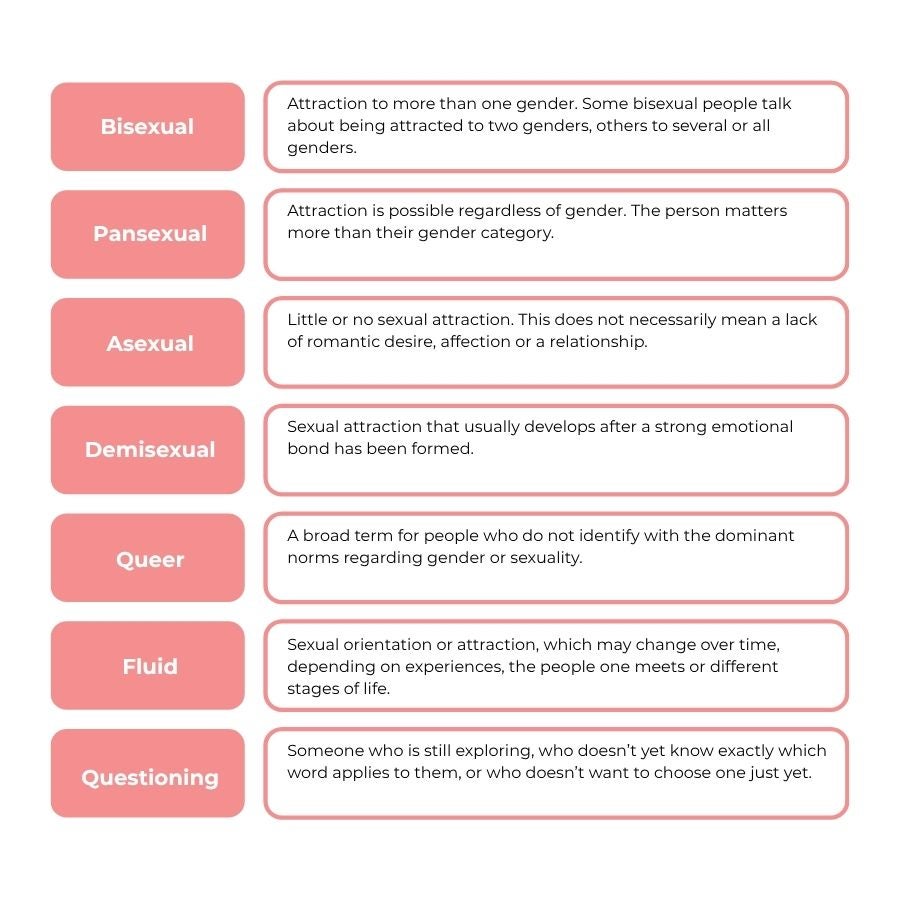
This last point is important: you have the right not to know. You also have the right to change the term, return to a previous one, use several, or none at all. Your sexual orientation is not a contract signed in triplicate.
Labels can be liberating … if used with care
A label can do a lot of good. It can bring a sense of relief: ‘Ah, there’s a word for that.’ It can help you find a community, seek out resources, set boundaries, better understand your own sexual orientation, or feel less alone.
But a label can also become a burden if it’s forced upon you. No one should have to constantly justify themselves, prove their sexual orientation, or choose a word before they’re ready. You can simply say: “I feel queer”, “I think I’m pan”, “I’m still figuring it out” or “I don’t want to describe this with a single word”.
Inclusivity often starts with simple gestures: listening, asking questions respectfully, using the words the person chooses, not making assumptions, and not turning a private conversation into an unwanted public debate.
Sexuality as a journey, not a destination
We tend to like pigeonholing things because it gives the impression that everything is neatly sorted. But people love to be a bit more chaotic. Attraction can remain constant throughout one’s life or it can change. It can be obvious, confusing, joyful, discreet, intense, non-existent or surprising. It can also depend on security, trust, context or encounters.
Viewing sexual orientation as a journey helps to ease the pressure. You don’t need to have the perfect answer today. You don’t need to choose a label just to reassure others. You can move forward at your own pace, try out terms, keep them, drop them or pick them up again later.
Terms relating to sexual orientation aren’t cages. They’re tools. Signposts. Bridge words. Sometimes they let you say, ‘That’s me.’ Sometimes they simply let you say, ‘I’m still figuring it out.’ And that’s already a lot.
Whether you’re queer, pan, fluid, bi, ace, questioning or unlabelled: it doesn’t matter whether you fit into the ‘right’ box. What matters is that you feel validated in your own life experience. And when it comes to pleasure, it’s the same: everyone moves forward according to their own desires, pace and preferences. Whatever your sexual orientation, you can find ideas on Amorana to help you explore what feels good for you, particularly through our bestsellers, designed to cater for all kinds of curiosity and desire.
If this guide can help anyone feel better understood, please share it. The more we talk respectfully about sexual orientation, the more space we create for acceptance.